Clallam County Amateur Radio Club

Welcome to the Clallam County Amateur Radio Club. We are a community of hobbyists, helpers, and friends dedicated to the art and science of radio.

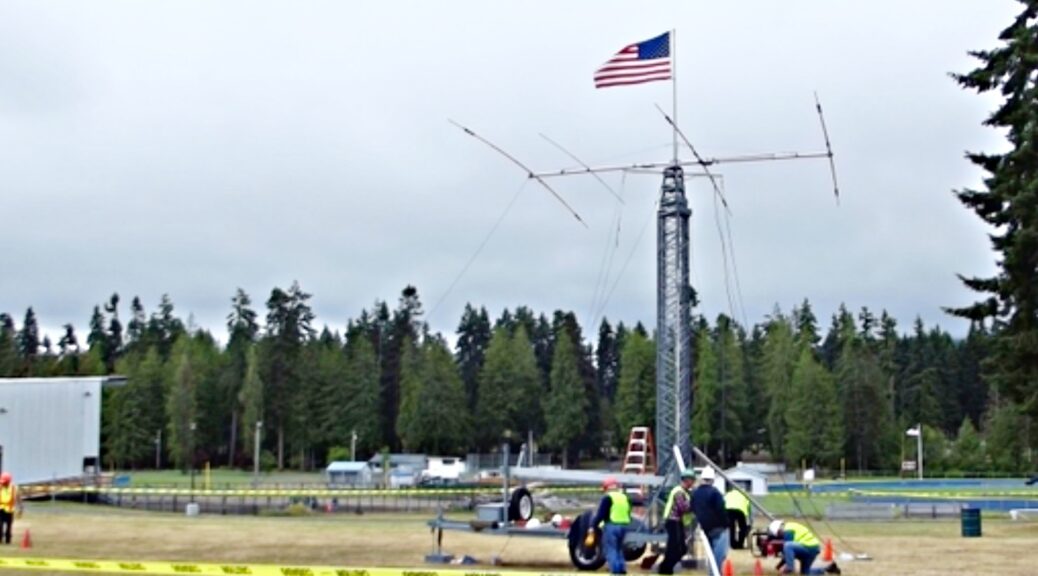
IMAG0121 1024x613
mathew lawson colage in packet section

CCARC Contact Information


CCARC Mailing Address
Clallam County Amateur Radio Club
P.O. Box 1631
Port Angeles, WA 98362
CCARC Officers
President
John DeVries, KK7PJL
Vice President
Sheldon Koehler, N7XEI
Treasurer
Jeramey Johnson, KF7PMC
Secretary
Jeramey Johnson, KF7PMC
CCARC Club Committees
Membership Chairperson
Lee Bond, N7KC
Net Coordinator
John DeVries, KK7PJL
W7FEL License / Repeater Trustee
Charles (Chuck) Stroeher, WA7EBH
Public Relations
John DeVries, KK7PJL
Technical Committee
Charles (Chuck) Stroeher, WA7EBH
Doug Welcker, WB4KGY
Bob Sampson, K6MBY
Bill Peterson, K7WWP
Edward Bowen, N7OZZ
Field Day Committee
Vacant
Newsletter
Vacant
Web Site Ad


ministrator
Bill Peterson, K7WWP
Program Committee
Vacant

Please use this for to contact our Club President. In the past we have listed phone numbers in the contact box but the amount of spam became too great. Thank you for understanding.

← Back

Thank you for your response. ✨

ACwAAAAAAQABAAACADs=


W7FEL CCARC Repeater 146.760 MHz   The Clallam County Amateur Radio Club owns, operates, and maintains a Bridgecomm System 2m VHF-FM repeater located at the State DNR’s Striped Peak communications site. The Club has maintained a repeater online at this location for over 20 years. The old GE Master II Repeater was replaced with the Yaesu in April, 2015 and the again in xx/xx/xx with the Bridgecomm.

As of xx/xx/xx we have installed a repeater in the Forks area on Gunderson Mountain, another Bridgecomm and it is linked by 440 MHz radios to Striped Peak. The purpose of this repeater is to enhance FM communications in Clallam County beyond the limits of simplex operation, allowing for wide-area coverage in and around Clallam County. Both the CCARC and CCARES/RACES organizations reserve the use of the repeater during nets, emergencies, and planned events. Unless otherwise pre-occupied, the repeater is open for general use by all licensed hams, both north and south of the border. Ef3905cb 38cf 4155 8497 Ae9857539319Striped Peak Communications Site (click on picture to visit the W7FEL photo gallery)   E860f30e 549e 4400 81d0 E5b6c8942d52 Repeater Location and Coverage Area(click on picture to visit the ‘Location and Coverage Area’ section) See photos of our new W7FEL BRIDGECOM hardware, as well as other historical photos. The Striped Peak site is located approximately 11 miles west of Port Angeles, WA, near the town of Joyce; 26 kilometers south of Sooke, BC and 39 kilometers southwest of Victoria, BC. Striped Peak’s geographic location and the repeater’s current technical configuration allows for the repeater to cover many other areas in the region, from Everett to Vancouver, west to Port Renfrew and Neah Bay, and most of the Olympic National Park high country. Please visit the Location and Coverage page for details and maps.    Operation of the repeater requires a 2-meter FM transceiver capable of transmitting a CTCSS tone. For those unfamiliar with CTCSS (also known as ‘PL’ or ‘Channel Guard’) please click here for details.(Adobe Acrobat Reader required, use the link at left.) 060ad88d Db9a 4b6f B50b 455f442caca8   In addition to the main 100Hz CTCSS tone, the repeater also incorporates a ‘remote receiver’ to improve repeater reception in fringe areas, covering many areas that were previously ‘dead spots’. Please visit the Technical Section to learn more about remote receiver and how they are used in this application.   W7FEL RepeaterBasic Information (see the Technical Section for details) Repeater Output Frequency 146.760 MHz Repeater Input Frequency 146.160 MHz TX Offset -600 KHz (-0.6 MHz) TX CTCSS ‘PL’ Tone (required for repeater access.)

See Remote Receiver Project Status below. Striped (Central) Receiver 100.0 Hz     Carlsborg (East) Receiver 77.0 Hz Forks (West) 145.210 MHz 100.0 Hz RX CTCSS Tone (required for tone squelch operation.) 100.0 Hz .

Nets and Activities:There are two nets performed weekly by the CCARC and CCARES/RACES groups.Check out the ‘Local Activities’ page for details on these and other regularly scheduled nets.

The Carlsborg ‘east’ remote receiver is open for use. It is a ‘low-site’ that is located near the Game Farm in Sequim. With the installation of the new Yaesu repeater in April, 2015, there are some additional requirements to use this remote receiver. Please read the project documentation. The remote receivers, along with the repeater itself, all have battery backup and have the ability to operate for long periods of time on emergency power..   The repeater can’t stay on the air without your support ! The repeater’s equipment, operating, and maintenance costs are funded entirely by the membership of the Clallam County Amateur Radio Club, and donations to the Club. Because some of these costs are recurring on a yearly basis and ultimately absorbed by the CCARC, it is urged that all regular users of the repeater support the CCARC by maintaining membership with the Club.  

Frequency Coordination Information The W7FEL repeater’s main non-experimental components are coordinated in accordance with the Western Washington Amateur Relay Association policies and by-laws. This repeater has a co-channel agreement with the Federal Way Amateur Radio Club, which also has a repeater on the frequency of 146.760, located in the Auburn area. The FWARC repeater can be heard marginally in the east end of Clallam County, but after extensive field tests it has been determined that there is not enough evidence to claim that the FWARC system causes any ‘harmful interference’ to the CCARC repeater in its intended coverage area. The CCARC repeater is not heard at all in the FWARC’s coverage area.According to FCC rules, simply ‘hearing’ the FWARC repeater when the CCARC repeater isn’t transmitting is NOT interference; it’s an annoyance. If you wish to block your receiver from hearing the FWARC repeater but still be able to hear the CCARC repeater, enable the CTCSS “tone squelch decode” feature on your radio. Please read the following PDF article “Decoding the Secrets of CTCSS”, an article from the December 1996 article of QST, for more information about this concept. If your radio is incapable of this feature, using a Yagi antenna or raising the squelch on your receiver may eliminate the unwanted signal.

Repeater Contact Information: Please contact the W7FEL Repeater Trustee for additional technical information. Or you may contact the CCARC Club President for additional technical information.    
  Repeaters & IRLP in Clallam County

Many hams in the area frequently use repeaters to communicate with each other over wide areas using inexpensive mobile and handheld radio equipment, small antennas, and low power output.
While simplex radio communications has its advantages, using repeaters provides hams a single point to congregate on the air where everyone can hear each other regardless of location.
While normal, standalone repeaters range from local-area to region-wide coverage, linking repeater systems allow for ‘long-distance’ communications worldwide.
9k=

Repeaters
A repeater listing has been compiled, listing all repeaters usable within Clallam County. New Hams and Hams new to the area can use this listing as a guide to getting started on the air.
IRLP in Clallam County
Thanks to the information superhighway paving the way for worldwide Internet connectivity, the Internet Radio Linking Project has proven to provide worldwide communications using radio tranceivers as small as radio transceivers can get! In Clallam County, hams use IRLP nodes on a daily basis to talk to other hams around the world.


IRLP in Clallam County

 
From the creator of IRLP

The Internet Radio Linking Project was started back in November of 1997 as an attempt to use the internet to link radio systems across Canada. The first full time link that was established ran from Vancouver, BC to Saint John, NB. The link had many problems and was shut down in March of 1998 due to the numerous computer crashes and repeater lockups it was causing, and the lack of user control over the system.
IRLPlogo
 
I set out to design a better way to use the same technology to perform the same task, while improving usability, user control, and sound quality. My first breakthrough was to replace the existing operating system, Windows, with a more stable and versatile language. I chose Linux, a IBM form of the operating system UNIX, because of its superior networking characteristics, its reliability, and its ease of programming.
I designed my own interface board to interface the radio to the computer. This allowed a large amount of delay to be removed from the system because two VOX circuits were no longer being used . I also wrote my own custom control software, and modified an existing voice-over-IP software package to accommodate the project.
The final product was a combination of hardware and software that created a nearly seamless radio link between two remote sites on the internet. The product works so well that many people can not believe that they are talking through a link at all!

Clearpixel
Dave VE7LTD


What is IRLP?
IRLP is an acronym for the Internet Radio Linking Project, the brainchild of Dave Cameron VE7LTD of Vancouver BC. IRLP is a state-of-the-art technology concept that links VHF/UHF-FM radio equipment together via the Internet (widely known as VoIP – Voice over IP), similar to how and why some large repeater systems are able to cover such a wide area. Without getting into detail, IRLP basically allows you to have a conversation with another ham or hams around the world by either connecting a local IRLP-equipped repeater or simplex base station to a remote repeater or simplex base station at a different location (known as a node), or by answering an incoming call initiated by a ham from a remote node. Here’s an example:


Example2


From what this sounds like, IRLP isn’t ham radio
This issue depends on how each ham interprets ham radio and IRLP. It’s another method of conveying messages around the world, using wireless radios at each end. As K4KR states, “Is this the end of HF? [No.] HF radio is a very different kind of magic. On HF, you [can] build your own station and send your own signal to the other side of the earth. Just because Internet Linking allows you to talk to people around the world doesn’t mean it compares to HF. Hams get involved in HF to experience the magic of radio, not simply to talk to people around the world. There are many, non-ham-radio ways to talk around the world.” While it is true that radios are not connected directly to each other, there are radios fully utilized at each end which makes the experience just as interesting and has a multitude of contemporary real-world applications. By no means does IRLP intend, nor will IRLP EVER, replace skywave and satellite communications; IRLP is simply just another method, and has its limitations and vulerabilities as well, such as power and/or connectivity outages due to anything from an accidental cable-cutting mishap to catastrophic events such as an earthquake.
It’s understood that this is an issue that ruffles the feathers of many hams, for and against IRLP. Before complaints are sent to the node owner, please read an interesting
eHam.net article regarding IRLP. Located there are is about a year’s worth of readers’ messages for and against IRLP, and has some very strong points that must be considered before one becomes closed-minded about their opinion.
How do I find out more about IRLP?
Start here:
IRLP.net The Official IRLP website
Then check out the following web sites:

IRLP in Australia – An excellent place to read up on what IRLP is all about

IRLP Suggested Operating Procedures for IRLP Users – How to use IRLP

IRLP in depth – Another Canadian Invention is Sweeping the World

Groups.io – IRLP information and discussion
Before using ANY IRLP or EchoLink node
Please be aware of the guidelines specific to each node prior to use. Reading and following the node guidelines is a manditory requirement and is expected to be followed every time you use IRLP or EchoLink.
Guidelines common to all IRLP nodes, including reflector use, proper protocol, error messages, do’s and dont’s, and other tips are located at the official IRLP website:

http://www.irlp.net – click on ‘IRLP guidelines’
See the EchoLink website regarding EchoLink procedures, use, etc. at
http://www.echolink.org
What nodes are available around here?
Here are a few well-known IRLP nodes within range of our area.
Click on the node for more information.
Node 3249 – W7FEL–R, 146.760
Joyce, WA, Striped Peak (public access) (repeater node)
Node 1000 – VE7RHS, 145.270
University of British Columbia, Vancouver, BC (repeater)
Node 1020 – VE7RNA, 146.680
Cowichan Valley ARS, Chemanius, BC (repeater)
Node 1030 – VE7VIC, 146.840
Westcoast ARA, Victoria, BC (repeater)
Node 1040 – VE7RTC/VE7RSX, 443.950 & 52.830
Westcoast ARA, Victoria, BC (repeater)
Node 1170 – VE7RIA, 147.585
Victoria Communications Club, Victoria, BC (simplex node)
Node 1520 – VE7RRU, 446.025
Victoria Communications Club, Victoria, BC (simplex node)
Here is a document that details how to use IRLP in Clallam County.
Who can I conctact locally about IRLP?
Contact Bob by email at k6mby@olypen.com

How To Use IRLP on Striped W7FEL

July 1, 2015
W7FEL-­‐R IRLP Node Number 3249
The 3249 IRLP node is currently open-­‐for use by all licensed amateur radio operators. Use the standard IRLP method to connect to r emote nodes by sending the 4 digit remote node number with your radioDTMF pad. To disconnect, send “73” on your DTMF pad. Any remote node may also connect to node 3249 unless a control operator has disabled the node or otherwise limited IRLP connections.
If you have never talked over an IRLP connection, please review the links noted below. One important tip to remember, pause for a second after you key the MIC before you speak. This allows the
connection to complete across the network and helps avoid dropping syllables or words from the start of your transmission. See additional operating instructions below.
See www.irlp.net for Operating Guidelines and a list of active nodes.

The following DTMF code list controls features of the W7FEL IRLP system.

DTMF Code Description
Key radio, push nnnn -­‐ Connect to lRLP node or reflector number. No prefix is required.
Key radio, push 73 -­‐ Disconnect from node or reflector.
Key radio, push A1 -­‐ Reply with Node Status
Key radio, push A2 -­‐ reply with Node Name and Time
Key radio, push A3 -­‐ reply with Last call received
Key radio, push A4 -­‐ Reply with Last outbound call

How to use Echolink on Striped W7FEL


W7FEL-­‐R Echolink Node Number 557235
EchoIRLP is a project with a goal to share hardware and software resources for IRLP and Echolink systems. The EchoIRLP Yahoo Group explains this project in more detail. Software is installed that allows
the IRLP node system to connect to Echolink network node.
The software we have installed on the W7FEL IRLP node is referred to as the “EchoIRLP” project.

What this software does or does not do:
-­‐ does not allow you to cross connect the IRLP and Echolink networks together.
-­‐ does provide the W7FEL IRLP node access to available Echolink clients and conferences.
-­‐ does allow Echolink clients to connect to the W7FEL-­‐R Echolink node number 557235
Note: We are currently filtering Echolink PC client nodes that connect to the W7FEL-­‐R system. Echolink repeaters, links and conferences are not filtered. Outgoing connections from W7FEL-­‐R are also not filtered. This was implemented due to the number of silent connections, mostly from Echolink PC clients. If your Echolink connection to W7FEL-­‐R is rejected with a “not allowed” message, then your Echolink client node is being filtered. The following DTMF code list controls the operation of the W7FEL-­‐ R EchoIRLP node. You will see the operation is very similar to using IRLP. General EchoIRLP controls would be prefixed with “D”. This insures EchoIRLP node numbers are differentiated from IRLP node
numbers. Contact the node operator/controller, with any questions or problems.

DTMF Code Description
Key radio, push 73 -­‐ Disconnect from node, reflector or conference.
Key radio, push Dnnnnn -­‐ Connect to Echolink node number.
You must send all digits without un-­‐keying or dropping out of the repeater. Visit the Echolink current
logins listing web page for a list of active Echolink nodes or list the area Echolink nodes from the node
status search page. .
Echolink Status -­‐All nodes _
Echolink Link Status -­‐ Search by area
Basic Operating Instructions

  1. The User should check the IRLP “node info” list at www.irlp.net or the Echolink node list at
    http://www.echolink.orq/logins.jsp to determine the availability of a given individual or
    reflector node.
  2. The User dials the desired IRLP node connect command. NNNN for IRLP or DNNNNN (up to 6
    digits in node number) for Echolink.
  3. The IRLP or Echolink system responds with a voice message indicating connection to the distant
    node.
  4. The go ahead “courtesy” tone will be slightly delayed for the 1 second turnaround time and will
    change to indicate to all users that the repeater is in the IRLP or Echolink mode and to refrain
    from local activity.
  5. If the distant individual node is busy with IRLP or Echolink or other RF traffic, the IRLP system
    will respond with “…node busy…”.
  6. lt is desirable to monitor for 10 seconds prior to voice announcing your CQ, call, and location so
    that a QSO that might be in progress on the distant repeater can adjust to your node
    connection.
  7. It is desirable to wait 1 second or more between each transmission to account for turn system
    around delays.
  8. It is also recommended to wait 1 second or more after PTT to starting voice.
  9. If there is no activity by either node within about 4 minutes, the nodes will be automatically disconnected.
  10. Especially while connected to an IRLP reflector or Echolink Conference, it is common courtesy to pause between transmissions to allow breakers and for nodes to be able to enter DTMF disconnect commands.
  11. When connected to a reflector, it is desirable to not have a long separate rag chew on the local
    node. Please disconnect the node from the reflector.
    Disconnecting a node connection:
  12. The Member dials the IRLP or Echolink disconnect command 73
  13. The distant IRLP or Echolink node will announce with a specific voice message that you are
    disconnected from the node.
  14. The go ahead courtesy tone will return to normal to indicate to all users that the repeater is not
    in the IRLP or Echolink mode.

REPEATER COVERAGE AREA-work in progress

Not familiar with the Olympic Peninsula area of Washington State?
Click on ‘Area Information’ for details.

Striped Peak is geographically located northeast of Joyce and west of Sequim and Port Angeles. Located in the central part of Clallam County, it allows for hand-held radios to be used in most of the Port Angeles area and all of Joyce. In Sequim, hand-held coverage is marginal through the Striped Peak receiver but is available through the east end remote receiver (77Hz tone). 

In the west end, coverage is much more marginal due to heavy mountinous terrain. High-power mobile and base stations must be used. Many lowland locations can hear the repeater weak, but may or may not be able to access the repeater. The west end remote receiver (186.2Hz tone) allows easier access for users in this area. Higher locations typically have no trouble receiving or accessing the repeater.


Radio PropAgation Study Maps

A number of radio propogation studies have been performed to give a basic representation of the repeater’s transmit and receive coverage. Although these studies were adjusted to depict actual coverage as accurately as possible, all data is approximate and should be used at everyone’s own risk. These studies are also subject to atmospheric conditions.
The software used to produce this study is ‘Radio Mobile’ by Roger Coude VE2DBE

Dark orange indicates solid to slightly marginal signal.
Light orange indicates marginal to no signal at all.

Striped Peak’s location relative to the east (picture below) and west (right picture) ends of Clallam County. The red arrow points to the Striped Peak site and blue arrows point to the remote receivers. screenshot 2026 05 04 at 6.29.51 pm
Need map for Ellis and Gundersonscreenshot 2026 05 04 at 6.30.13 pm

 
Repeater’s approximate transmit coverage received by an average base station or stationary mobile radio. This study is also the repeater’s approximate receive coverage by a base station or stationary mobile radio with gain antenna transmitting at 50 watts using the main 100Hz CTCSS tone.
screenshot 2026 05 04 at 6.31.56 pm
 
  
Repeater’s approximate receive coverage by a hand-held radio with rubber duck antenna transmitting at 5 watts using the main receiver, 100Hz tone.
screenshot 2026 05 04 at 6.32.09 pm
 
Repeater’s approximate receive coverage by a hand-held radio with rubber duck antenna transmitting at 5 watts using the east receiver, 77Hz tone.
77 Hz from Carlsborg
 
Need an Ellis write up
screenshot 2026 05 04 at 6.29.51 pm

Clallam County Area Information

MapClallam County is the northwesternmost county in Washington State and the continental United States. Clallam County is on the North Olympic Peninsula, a large mass of land mostly surrounded by both ocean and inland beach. Port Angeles is the county seat, approximately 60 miles (72 road miles) northwest of Seattle.
  
About 1 million acres of land on the Olympic Peninsula have been set aside as the Olympic National Park, an area that has unique and distinct biological qualities found nowhere else in the world. 95% of the Olympic National Park land is designated wilderness. Olympic National Park contains ecosystems such as old-growth and temperate rain forests, 60 miles of wild coastline, and rugged, mountainous terrain up to heights of about 8,000 feet.
. Olym 01    
 
 port angeles harborPort Angeles is the largest town in Clallam County, with a population of about 19,000 (7/08) Port Angeles WebCam Located on the the Strait of Juan de Fuca and bordering with the Olympic National Park, Port Angeles is unique where you can travel by car from the waterfront to the heart of the mountainous wilderness in about an hour

According to the FCC ULS database January 2010, there are 624 licensed hams
that are registered with a mailing address within Clallam County.

Port Angeles

300
Sequim
288
Carlsborg
15
Forks
10
Neah Bay
2
Joyce
3
Beaver
1
Seiku3
La Push2

Local Ham Radio Activities in Clallam County

mathew lawson colage in packet section

Interested in getting started in Ham Radio, or are you not sure of what Ham Radio is all about? Check out ARRL’s “Getting Started in Ham Radio” Page. Also check out our Ham Classes page.
New to the area? Interested in finding out more about Clallam County? Click on “
Area Information ” for details.
      
For updates/corrections/additions, please contact the web manager through the link at the left.
Clallam County ARES Activities
The Clallam County ARES/RACES group provides auxiliary communications for the Red Cross, County and City agencies in times of need. To receive the latest information on CCARES activities, listen to the CCARES radio net (listed below), or contact any ARES member. Visit the CCARES web page for details.You may also wish to view our Club Calendar of Activities.

Clallam County Amateur Radio Club Activities
The Clallam County Amateur Radio Club locally supports the interests of Ham Radio and for the fellowship of interested hams and non-hams alike.
To receive the latest information on CCARC activities (including ham radio license classes and ARRL volunteer examination sessions), listen to the CCARC radio net (listed below) or contact one of the CCARC board members. Visit the CCARC web page for details.
Regular Meetings and Gatherings (both CCARES/RACES and CCARC)

Description
Time/DateLocationContact
Clallam County ARES/RACES general meeting7 pm, first Tue. of every month except DecemberClallam County
Courthouse EOC, 223 E. 4th St.
, PA
Bill Carter W7WEC
Zoiper Click2Dial360-681-4375US
Clallam County Amateur Radio Club general Club meeting7 pm, second Wednesday of every monthPort Angeles First United Methodist Church
7TH & Laurel Street, PA
Clallam County Amateur Radio Club social breakfastSecond Saturday of every month.See Club Calendar
Link to calendar
Radio Nets
If you are a member or visitor, check-ins are welcome with the radio nets listed below. Visitors are
encouraged to check in regardless of location.
DescriptionTime and DateFrequencyNet Control
Clallam County ARES/RACES Net7 pm, every Tuesday except for the 1st week of the monthW7FEL Repeater
146.760 –600, 100 Hz Tone
Clallam County
Amateur Radio Club Net

7 pm, every Thursday
W7FEL Repeater
146.760 –600, 100 Hz Tone
Latter Day Saints (LDS) Emergency Net (open to all)
6 pm, every Sunday
W7FEL Repeater
146.760 –600, 100 Hz Tone
Elwha Emergency Net (open to all)
7 pm, every SundayW7FEL Repeater
146.760 –600, 100 Hz Tone
WARA (West Coast Amateur Radio Association) Club Net (Victoria, BC)7 pm, every Monday
VE7VIC Repeater
146.840 –600, 100 Hz Tone
WARA (West Coast Amateur Radio Association) Emergency Net (Victoria)7 pm, every WednesdayVE7VIC Repeater
146.840 –600, 100 Hz Tone
Simplex Net immediately following: on 146.580

Repeater Technical Information


W7FEL Striped Repeater System
The W7FEL repeater’s main transmitter and receiver are located at the State DNR’s Striped Peak communications site. This site hosts equipment operated by local, county, state, and federal public agencies, as well as TV translators and a high-power FM broadcast transmitter.
The repeater’s radio equipment consists of commercial two-way radio equipment manufactured by Motorola and GE (now known as M/A-Com). Because this site has a number of transmitters and receivers located very close to one another, careful and professional site engineering practices must be followed to prevent intermodulation and other types of interference, requiring expensive intermod surpression and filtering equipment in addition to the repeater’s standard equipment.

image

Striped Peak Site Equipment

Transceiver
Duplexer
Isolator/Circulator
Transmitter Filtering
Feedline
Antenna
Repeater ControllerSierra Radio SRS200
Link Radio
Motorola MaxTrac UHF
Link Antenna/FeedlineAntenex Y-4303 3-Element Yagi, Andrew LDF4-50A Heliax (50ft. run)
Power SupplyAstron RM-50M-BB, linear 37 amp (cont. duty) /w Battery Backup

Forks (Gunderson) Site Equipment

Transceiver
Duplexer
Isolator/Circulator
Transmitter Filtering
Feedline
Antenna
Repeater Controller
Power Supply

Ellis Lookout Site Equipment

Transceiver
Duplexer
Isolator/Circulator
Transmitter Filtering
Feedline
Antenna
Repeater Controller
Power Supply

Brigadoon Site Equipment

Transceiver
Duplexer
Isolator/Circulator
Transmitter Filtering
Feedline
Antenna
Repeater ControllerSierra Radio SRS200
Link Radio
Motorola MaxTrac UHF
Link Antenna/FeedlineAntenex Y-4303 3-Element Yagi, Andrew LDF4-50A Heliax (50ft. run)
Power SupplyAstron RM-50M-BB, linear 37 amp (cont. duty) /w Battery Backup

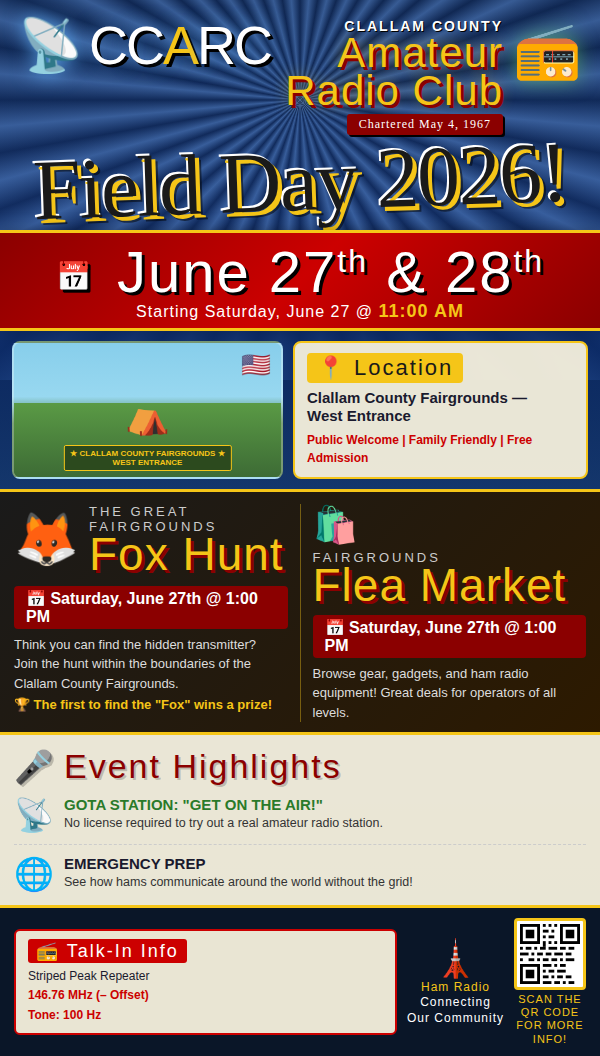
CCARC Field Day in Clallam County

What is Field Day?

According to Wikipedia, Field Day is an annual amateur radio exercise, widely sponsored by IARU regions and member organizations, encouraging emergency communications preparedness among amateur radio operators. In the United States, it is typically the largest single emergency preparedness exercise in the country, with over 30,000 operators participating each year. In North America, Field Day is always the fourth full weekend of June, beginning at 1800 UTC Saturday and running through 2059 UTC Sunday.

Since the first ARRL Field Day in 1933, radio amateurs throughout North America have practiced the rapid deployment of radio communications equipment in environments ranging from operations under tents in remote areas to operations inside Emergency Operations Centers (EOCs). Operations using emergency and alternative power sources are highly encouraged, since electricity and other public infrastructures are often among the first to fail during a natural disaster or severe weather.

To determine the effectiveness of the exercise and of each participant’s operations, there is an integrated contesting component, and many clubs also engage in concurrent leisure activities (camping out, cookouts, etc.). Operations typically last a continuous twenty-four hours, requiring scheduled relief operators to keep stations on the air. Additional contest points are awarded for experimenting with unusual modes, making contacts via satellite, and involving youth in the activity.

Scroll to Top